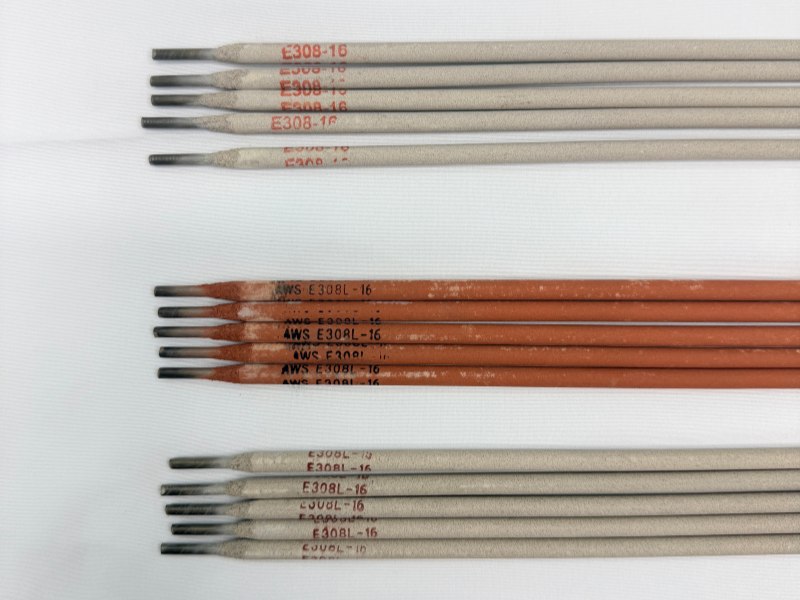
AWS A5.4 Stainless Steel Welding Electrodes: Classification, Coverings and Selection
This is the entry point to our AWS A5.4 section. It sets out what the specification controls, how to read a designation such as E308L-16, what the -16 covering commits to on the shop floor, and how to move from a base metal to an order line.
Written for purchasing teams, welding engineers and inspectors. It does not qualify a procedure, set acceptance criteria, or replace the standard text, your WPS/PQR, or the records issued against a supplied lot.
1. Start here: what this page covers, and what it does not
Covered here
Covered stainless SMAW electrodes; classification logic; usability codes; the -16 / titanium-calcium covering family; selection by metallurgical family; base-metal pairing; storage variables; the documents an order should name; sizes and packing variables reviewed per order.
Not covered here
Procedure or welder qualification, service-specific corrosion and impact testing, pricing, and equivalence declarations between AWS, ISO, GB/T, JIS or EN systems. Where a project requires one of these, it belongs in the order and the procedure documents.
2. The specification: scope, edition and the two unit systems
AWS A5.4/A5.4M, Specification for Stainless Steel Electrodes for Shielded Metal Arc Welding, is published by the American Welding Society. The edition listed on the AWS A5 Committee register is A5.4/A5.4M:2012 (R2022), 11th edition, revising the 2006 edition. It is also adopted as ASME SFA-5.4 in Section II, Part C of the ASME Boiler and Pressure Vessel Code. Confirm the edition named in your purchase documents rather than assuming the one shown here.
Scope. The deposited weld metal contains not less than 10.5% chromium, and iron exceeds any other element; for classification purposes iron is derived as the balance. The standard notes that no attempt has been made to classify every filler metal grade within that scope — only widely used grades are included.
Two unit systems. A5.4 uses U.S. customary units and A5.4M uses SI units. The values are not exact equivalents; each system is used independently without combining values.
What it controls. Classification, acceptance, the certification clause, rounding-off, a summary of tests, retest rules, weld test assemblies, chemical analysis of undiluted weld metal, radiographic soundness, all-weld-metal tension testing, fillet weld testing, method of manufacture, standard sizes and lengths, core wire and covering, exposed core, electrode identification, packaging and package marking. Informative Annex A includes application guidance and a comparison with ISO 3581; Annex B addresses technical inquiries.
What it does not control. Corrosion and scaling behaviour are special tests arranged between purchaser and supplier. Safety and health sit outside its scope and are referenced to documents such as ANSI Z49.1. Procedure qualification belongs to construction codes such as ASME Section IX.
| Document | What it governs | How it shows up on an order |
|---|---|---|
| AWS A5.4/A5.4M:2012 (R2022) | Covered stainless SMAW electrode classification | Standard + edition + full classification incl. suffix |
| ASME SFA-5.4 (BPVC Sec. II, Part C) | The AWS specification as adopted for code work | SFA-5.4 cited alongside the construction code |
| AWS A5.01M/A5.01 | Procurement: lot class and intensity of testing | Lot class and test schedule letter, where specified |
| ASME BPVC Section IX | WPS/PQR qualification and filler groupings | P-No., F-No., A-No. on the WPS; verify current QW tables |
| ISO 3581 (System A / B) | ISO classification of covered stainless electrodes | E 19 9 L R 3 2 (A) or alloy-code style (B) |
| GB/T 983-2012 | Chinese standard; modified adoption of ISO 3581:2003 | E308L-16-style model; retains its own test items |
| AWS A4.2 / ISO 8249 | Ferrite measurement method | FN value and method where a ferrite band is specified |
| EN 10204 | Types of inspection documents | Certificate type plus the required test list |
Among its neighbours: AWS A5.9 covers bare stainless wires and rods for GTAW/GMAW/SAW, A5.5 covers low-alloy covered electrodes, A5.11 covers nickel-alloy electrodes; the older E502, E505 and E7Cr moved to A5.5. A frequent order-line error is writing ER308L for an SMAW job: that is a bare filler under A5.9, while E308L-16 is a covered electrode under A5.4.
3. Decoding a designation, one segment at a time
Type or paste a designation to see how the code breaks down. The reading below is a routing aid; the datasheet for the supplied lot remains the authority.
| Segment | Reading | What it fixes |
|---|---|---|
E | Covered electrode for SMAW | Product form and process |
316 | Weld-metal composition family | Chemistry window of the undiluted deposit |
L | Composition variant | A tighter limit within that family |
-16 | Usability designation | Covering system, current type, position capability |
Covering: Rutile / titania (titanium-calcium) covering. Current: AC or DCEP. Position: All positions; vertical-down generally excluded; larger diameters flat/horizontal. Soft arc, fast-freezing slag, easy release. AC stability comes from ionising salts in the covering.
Family routing: 316 / 316L molybdenum-bearing family. Base metals commonly paired: 316 / 316L, cast CF8M. Selection driver: Chloride-bearing duty; match the Mo level.
Reference decoding only. The datasheet for the supplied lot, the WPS and the batch records govern the order; corrosion, impact, ferrite and hydrogen values are not fixed by the suffix.
Letters after the number carry chemistry meaning: L low carbon, H higher carbon, Mo molybdenum-bearing, Nb niobium stabilised, LR low residuals, Mn raised manganese, NiMo nickel-molybdenum. The digits may be three or four characters.
E304L in A5.4; a 308-type deposit is deliberately alloyed above a 304-type base metal so the deposit retains a controlled ferrite fraction on solidification. Second, the suffix is usability, not composition: two electrodes sharing an alloy family but carrying different suffixes are classified against the same chemistry and mechanical limits. Operating behaviour still varies with the manufacturer's formulation.Two further details inspectors ask about: AWS A5.4 includes a table of potentially dual-classified electrodes and suggested marking, so ask for the exact carton marking rather than inferring it; and the standard's scope cautions that core wire taken from a covered electrode should not be used as bare filler wire, because the covering is part of how the deposit chemistry is achieved.
4. The -16 covering: what the code commits to in the shop
Naming
AWS describes -16 as a titania / rutile covering. Chinese and some Asian datasheets call the comparable operating family 钛钙型 (titanium-calcium / titania-calcium). These describe comparable arc behaviour; they are not identical specification definitions, and neither should be written as the other's equivalent on a certificate.
Composition logic
Rutile (TiO₂) is the principal slag-forming constituent, with calcium-bearing minerals and a potassium silicate binder. Readily ionising potassium compounds keep the arc stable on alternating current. The slag freezes comparatively quickly, which is what makes positional work manageable.
Current and position
-16 products are designed for AC or DCEP (electrode positive, DC+). DCEP remains the reference condition on published manufacturer datasheets; AC operation can bring more spatter, a shallower pool and more covering reddening at higher currents. Smaller diameters are generally usable in all positions with vertical-down commonly excluded; larger diameters are usually restricted to flat and horizontal work. Check the applicable edition's Table 2 and the maker's size table.
Behaviour
Soft, dispersed arc; low spatter; good wetting; a smooth flat-to-slightly-convex bead on fillets; slag that lifts without heavy chipping. Deposition rate is lower than the flat-position -25 / -26 variants.
-16 does not promise. It does not set a diffusible-hydrogen level, a low-temperature impact value, a corrosion-test result, a moisture limit or a ferrite number. Those are properties of a specific product and a specific lot, documented in the TDS and in whatever special tests the purchaser and supplier agreed. A classification code is purchase language, not a performance claim.Where another suffix is written instead: a -15 basic covering is DCEP-only; -17 adds silica for a more fluid pool and a flatter bead on horizontal fillets; -25 / -26 are flat-and-horizontal production variants.
5. Five usability codes side by side
-16 · Rutile / titania (titanium-calcium type)
Current: AC or DCEP. Position: all positions, with vertical-down generally excluded; larger diameters flat/horizontal. In use: soft arc, fast-freezing slag, easy release, low spatter, flat-to-slightly-convex fillet bead. Check: AC arc stability if an AC set will be used, and the size-specific position table.
| Code | Covering system | Current | Position capability | Behaviour in use |
|---|---|---|---|---|
-15 | Lime / basic | DCEP only | All positions for smaller diameters | Forceful arc, deeper penetration, heavier spatter |
-16 | Rutile / titania (钛钙型) | AC or DCEP | All positions (vertical-down generally excluded); larger diameters flat/horizontal | Soft arc, fast-freezing slag, easy release |
-17 | Rutile with increased SiO₂ | AC or DCEP | All positions; slower-freezing slag needs a slight weave on vertical-up | Flatter to concave fillet bead, finer ripples |
-25 | Basic-type, alloying largely in a heavier covering | Per the applicable table | Flat and horizontal only | High deposition for large fillets |
-26 | Rutile-type counterpart of -25 | Per the applicable table | Flat and horizontal only | High deposition, smooth flat-work bead |
Which usability codes appear, and the position/current columns that define them, belong to the table in the edition your order names: the 2006 edition reintroduced -25 and -26 for flat and horizontal work, and the -17 family was separated from -16 because the operating differences had become significant. No code in this table changes the composition limits of the alloy family it is attached to.
6. Selection overview: route by metallurgical family, not by grade number
| Family | Representative classifications | What drives the choice | Base metals commonly paired | Additional checks |
|---|---|---|---|---|
| 308 / 308L / 308H | E308-16, E308L-16, E308H-16 | Carbon level versus service and heat treatment | 304 / 304L / 304H, 302, cast CF8 / CF3 | L where the assembly is not solution annealed; H where creep strength is specified |
| 309 / 309L / 309Mo | E309L-16, E309LMo-16 | Dilution from a lower-alloy side | Stainless to carbon steel; first cladding layer; 309 base metal | Buttering layer thickness; carbon-steel side still needs corrosion protection |
| 316 / 316L / 317L | E316L-16, E317L-16 | Molybdenum for chloride-bearing duties | 316 / 316L / 317L, cast CF8M | Mo match; ferrite band; post-weld cleaning |
| 347 / stabilised | E347-16 | Niobium stabilisation under repeated heating | 321 / 347, thermal-cycling parts | Whether an L grade is acceptable at the stated service temperature |
| 310 / 310H / 312 | E310-16, E312-16 | Heat-resisting 25Cr–20Ni deposit, or difficult dissimilar work | 310S, furnace parts; unknown or mixed stainless in repair | Long high-temperature exposure; trial weld on unknown material |
| 410 / 410NiMo / 430 | E410-16, E430-16 | Martensitic / ferritic metallurgy | 410, 430, matching castings | Preheat, PWHT, hydrogen control — a different procedure family |
| Duplex / superduplex | E2209-16, E2553-16, E2594-16, E2595-16 | Over-alloyed nickel to restore austenite on cooling | 2205 (S32205 / S31803), 2507 (S32750) | Heat input and interpass window; phase balance; any project corrosion test |
| Special austenitic | E16-8-2-16, E330-16, E320LR-16 | High-temperature or specific corrosive service | Matching specialty grades | Availability and lot-specific documentation |
7. Base-metal map: which families pair with which plates and pipes
| Base metal | UNS / EN reference | A5.4 family reviewed first | Notes |
|---|---|---|---|
| 304 / 304L | S30400 / S30403 · 1.4301 / 1.4307 | 308 / 308L | Confirm whether an intergranular-corrosion test is required |
| 316 / 316L | S31600 / S31603 · 1.4401 / 1.4404 | 316 / 316L | Match molybdenum; avoid downgrading to a 308-type deposit |
| 321 / 347 | S32100 / S34700 · 1.4541 / 1.4550 | 347, or 308L where service allows | Stabilisation needs depend on time at temperature |
| 304L to carbon steel | P-No. 1 to P-No. 8 joint | 309L first layer | Dilution and transition design control this |
| 310S / heat-resisting | S31008 · 1.4845 | 310 family | Check the full temperature cycle, not just the peak |
| 410 / 430 | S41000 / S43000 · 1.4006 / 1.4016 | 410 / 410NiMo / 430 | Preheat and PWHT are procedure variables |
| 2205 duplex | S32205 / S31803 · 1.4462 | 2209 | Heat input and interpass limits are normally in the WPS |
| 2507 superduplex | S32750 · 1.4410 | 2594 | Tighter window; project corrosion testing frequently specified |
| Cast CF8 / CF3 / CF8M | Casting equivalents | 308 / 308L / 316L | Review the actual casting certificate |
| Unknown / mixed repair stock | Not identified | 312-type, subject to a trial weld | Identify the material where the joint is load-bearing |
Confirm the governing material standard (for example ASTM A240 / A312, EN 10088 or the project specification) and the qualified WPS before the selection is fixed.
8. Where the classification meets the shop floor
| Variable | Why it matters | Where it is fixed |
|---|---|---|
| Delta ferrite / FN | A small ferrite fraction reduces solidification-cracking susceptibility in austenitic deposits; too much can affect low-temperature toughness or transform to sigma phase in warm service. Published target bands for 308L-type weld metal frequently sit around FN 3–10. | Project specification and WPS/PQR; measured per AWS A4.2 / ISO 8249. FN is a measurement scale, not a volume-percent figure. |
| Sensitisation | Chromium-carbide precipitation in roughly the 450–850 °C window reduces intergranular-corrosion resistance. L variants tighten the carbon limit for assemblies that are not solution annealed. | Carbon variant chosen against service and any heat treatment |
| Dilution | On dissimilar joints the carbon-steel side dilutes the pool; that is why a 309L-type first layer is reviewed before a matching top layer. | Joint design, buttering layer, current and arc length in the WPS |
| Heat input / interpass | Austenitic work is usually run with controlled heat input and a limited interpass temperature (150 °C is a figure often quoted in maker guidance). Duplex 2205 is commonly held to roughly 0.5–2.5 kJ/mm with interpass near 150 °C; superduplex 2507 is tighter, near 100 °C. | The qualified WPS. These are reference ranges, not classification requirements. |
| Martensitic / ferritic families | 410-type deposits can harden in the HAZ; preheat, interpass and PWHT dominate the outcome. | WPS/PQR and the applicable construction code |
| Contamination | Carbon-steel brushes or grinding wheels embed iron particles and can cause tea staining. Dedicated stainless tools, degreasing and post-weld cleaning protect the passive layer. | Shop procedure and the surface-finish requirement on the drawing |
| Qualification vs classification | A classification describes a consumable; a PQR qualifies a procedure. F-No. / A-No. groupings in ASME Section IX are qualification variables. | Current Section IX tables (QW-432 / QW-442) and the WPS |
| Fume and safety | Stainless consumables produce fumes containing chromium and nickel compounds; ventilation and PPE sit apart from the filler classification. | ANSI Z49.1, local regulation and the SDS for the supplied product |
9. Storage, re-drying and handling
Coverings pick up moisture from the air. Moisture is associated with porosity, arc instability and, in susceptible microstructures, hydrogen-related cracking. Keep unopened packs sealed and dry, move opened electrodes into a heated holding cabinet, and handle them as the datasheet for that lot describes.
There is no universal re-baking temperature. Published manufacturer instructions for -16 stainless electrodes differ:
| Published instruction | What it illustrates |
|---|---|
| 150–200 °C for about 1 h | Lower-temperature guidance for rutile-type coverings |
| 200–250 °C for 1 h | A commonly printed range on austenitic stainless datasheets |
| 250 °C for 2 h, with a cap on re-bake cycles and cumulative hours | A maker that limits repeated exposure explicitly |
| 300–350 °C for 1 h | Higher-temperature guidance often seen on domestic stainless electrodes |
10. Documentation and the purchase order
A workable order line names: the standard and its edition; the full classification including the suffix; diameter and length; unit system; quantity; packaging; the required inspection document; and any special tests agreed between buyer and supplier. "MTC required" or "stainless rod 3.2 mm" on its own leaves too much open.
Lot and testing language
AWS A5.01M/A5.01 gives buyers a vocabulary for this. For covered electrodes it defines lot classes (commonly shown as C1–C5, from the maker's standard lot through to a lot built from one dry blend and one core-wire heat) and testing schedules F through K: F is the maker's standard level, G draws on production runs within the preceding 12 months, H / I / J / K step up toward lot-specific testing, with J calling for the classification tests per lot shipped and K following purchaser-specified tests. The scope of each letter varies with product family and edition — name the letter and confirm its definition in the A5.01 edition cited.
Two different documents
Results under the lower schedules generally appear on a certificate of conformance and represent typical values from routine testing. Results generated per shipped lot appear on a lot-specific test report with actual values. If your inspection plan needs actual values for the delivered batch, ask for that explicitly.
Inspection documents
EN 10204 types 2.1 / 2.2 / 3.1 / 3.2 describe who issues the document and whether specific inspection or independent validation is involved. State the type together with the test list, traceability requirement and any witnessing party. A certificate type alone does not define which tests appear on it.
E308L-16 may be written under AWS A5.4, under ISO 3581 System B (in alloy-code form), and under GB/T 983-2012 — which is a modified adoption of ISO 3581:2003, keeps E rather than the ES prefix, adds a position "4" for vertical-down, and retains requirements for electrode eccentricity, deposit corrosion resistance and weld-metal ferrite content. ISO 3581 System A instead writes a nominal-composition designation such as E 19 9 L R 3 2, whose trailing digits describe covering, position and current in the ISO scheme — they are not a rendering of the AWS -16. A cross-reference finds the family; it does not establish contractual equivalence.What we can put in front of you. For the lot we quote, we can identify the classification, diameter, length, batch coding and the datasheet that applies to it, and we can state which of the documents above are available against that lot. If your project calls for a particular document form, a witnessed test or an inspection party, tell us before we quote; we will confirm what is available rather than describe a document we do not hold.
11. Hub directory: go to the page you actually need
Placeholder paths are for layout only. Replace with live URLs before publishing, and only link to child pages that carry their own substance — a hub full of thin, near-identical child pages is treated as a doorway set.
12. Sizes, lengths, packing and OEM
The following are reference sizes we are asked to quote against, not a standing stock declaration. Availability, current ranges and packing are confirmed per classification and per lot.
| Diameter | Reference length | Indicative current, AC / DCEP | Typical use |
|---|---|---|---|
| 2.5 mm (3/32″) | 300 / 350 mm | 50–85 A | Thin sheet, root passes, positional work |
| 3.2 mm (1/8″) | 350 mm | 80–120 A | General fabrication and pipe |
| 4.0 mm (5/32″) | 350 / 400 mm | 110–160 A | Fill and cap passes on plate |
| 5.0 mm (3/16–13/64″) | 400 / 450 mm | 160–200 A | Flat and horizontal production work |
Indicative only. Use the datasheet for the supplied batch and the qualified WPS; positional work and low-dilution requirements sit at the lower end.
On an order-by-order basis we can review cut length, kilograms per carton, the inner moisture barrier, whether the carton carries our name or yours, the language printed on the label, how the batch is coded on the outer case, and the pallet scheme. Non-standard diameters, unusual lengths and private-label artwork are reviewed against tooling, quantity and the classification being produced. We quote what has been confirmed for that order; we do not present these as unconditional commitments.
13. What to put in an enquiry
Copy this block and fill in whatever you have. A partial block is still enough for a first reply.
Classification (include the suffix):   e.g. E316L-16
Standard + edition named in the PO:    e.g. AWS A5.4/A5.4M:2012 (R2022)
Base metal(s) + form / thickness:     e.g. 316L plate, 8 mm, to 304L pipe
Service / code / WPS reference:       e.g. chloride duty, ASME VIII, WPS-214
Diameter x length x quantity:         e.g. 3.2 x 350 mm, 500 kg
Packing, label and document needs:    e.g. 5 kg carton, buyer artwork, lot report
14. Frequently asked questions
Is AWS A5.4 the same document as ASME SFA-5.4?
SFA-5.4 is the AWS specification as adopted into Section II, Part C of the ASME Boiler and Pressure Vessel Code. The classification content is aligned, but the document that governs your order is the one your code and purchase documents cite, including the edition. Name it on the order line.
Does the -16 suffix change the composition limits of E308L?
No. The usability designation addresses covering type, current and welding position. The chemistry window and mechanical limits belong to the alloy classification. Operating behaviour still differs between manufacturers' formulations, so read the datasheet for the lot.
Can an -16 covered electrode be run on a plain AC machine?
The AC capability is a stated purpose of this usability code: the covering contains readily ionising compounds that stabilise an AC arc. DCEP remains the reference condition on published manufacturer datasheets, and AC operation can bring more spatter and a shallower pool. Check the size-specific position and current table for the product.
Why is there no E304L classification in AWS A5.4?
Because the number identifies the weld-metal family, not the plate. A 308-type deposit is alloyed above the 304 base metal so that the deposit retains a controlled ferrite fraction on solidification. Matching the plate number would not give that solidification behaviour.
Which edition should I write on the order?
The one your project specification names. If the drawing only says "AWS A5.4", ask the design authority to state the edition; edition differences include which usability codes and classifications are listed. We will quote against the edition you name.
Do -16 electrodes need re-baking before use, and at what temperature?
Follow the datasheet for the batch you received and your WPS. Published instructions for -16 products range widely because covering formulations differ; Section 9 shows the spread and why a single number copied from another supplier's page is not a safe instruction.
Can the core wire from a covered electrode be used as a TIG filler rod?
The standard's scope cautions against this. The covering supplies part of the deposit chemistry and the shielding function; stripping it changes both. Use a properly classified bare filler under AWS A5.9 instead.
Who sets the acceptable ferrite number?
The project specification, the WPS/PQR and, where applicable, the construction code — not the -16 suffix. FN is measured on a defined scale (AWS A4.2 / ISO 8249) and is not the same thing as ferrite volume percent. Ask for the band and the measurement method before ordering if ferrite is an acceptance item.
Can I order a length or carton weight that is not in the table?
Send the requirement with the classification and quantity. Cut length, carton weight, inner barrier, artwork, label language and batch coding are reviewed against tooling and order size, and we will state what is available before quoting.